概率计算
|
(y == i).mean()
import numpy as np
y = np.array([1,1,2,2,3])
y_prob = {}
y_set = set(y)
for i in y_set:
    y_prob[i] = (y == i).mean()
y_prob
y_prob[i] = (y == i).mean()

该代码的特点:
思想一致:都是在计算离散变量的概率
高性能计算:效率高,计算速度快
效果一致:与理论上的结果一致
标签概率 标签是类别,类别的概率,即离散变量的概率计算,是数数 一类的个数/总个数 (y == i).mean() - y == i 真假列表 ,0或1 - y是一个向量,i是一个数值,会将向量的每个元素与i进行比较 - mean,1的个数加起来/总个数 ,即用一个函数mean替换了count/sum, |
|
P(y1|(x1,x2,x3)) = P(x1|y1) P(x2|y1) P(x3|y1)P(y1) P(y1|x) = P(y1|(x1,x2,x3)) = P(x1|y1) P(x2|y1) P(x3|y1)P(y1) x1,x2,x3是不同的特征,自有其特点/特性, 有不同的均值,标准差, 这里假设 - 所有特征相互独立 - 所有变量默认为连续变量 - 连续变量按概率密度求概率,自带归一化处理 - 因此,已经将他们拉到标准正态的维度上进行处理了 同时这里也有工程近似 - 该公式来自贝叶斯,对于既定的样本x,它的概率是定值,因为概率不像频率,本来就是定值 - 之所以抹去p(x),是相对y1,y2,...,yn来说的,目的在于取出它们中的最大值 - 而公式中的分母都是p(x),故可以抹去 |
|
X[y==0] import numpy as np X = np.arange(21).reshape((7,3)) X
array([[ 0,  1,  2],
       [ 3,  4,  5],
       [ 6,  7,  8],
       [ 9, 10, 11],
       [12, 13, 14],
       [15, 16, 17],
       [18, 19, 20]])
y = np.array([0,1,0,1,0,0,1])
X[y==0]
array([[ 0,  1,  2],
       [ 6,  7,  8],
       [12, 13, 14],
       [15, 16, 17]])
X[y==1]
array([[ 3,  4,  5],
       [ 9, 10, 11],
       [18, 19, 20]])
----------------------------------------------------------------- |
|
|
0相关
import numpy as np
ll = [1, 1, 0, 0]
a = np.array(ll)

# 方法1:np.nonzero
nonzero_indices = np.nonzero(a)
print("np.nonzero结果:", nonzero_indices)
print("索引列表:", nonzero_indices[0].tolist())


np.nonzero结果: (array([0, 1]),)
索引列表: [0, 1]


a[nonzero_indices[0]]
array([1, 1])
# 方法2:np.where
where_indices = np.where(a != 0)
print("np.where结果:", where_indices)
print("索引列表:", where_indices[0].tolist())


np.where结果: (array([0, 1]),)
索引列表: [0, 1]
|
|
|
|
|
|
|
|
生成一组数
import numpy as np
from matplotlib import pyplot as plt
x = np.linspace(start=-10, stop=10, num=50)
|
|
|
|
|
|
|
|
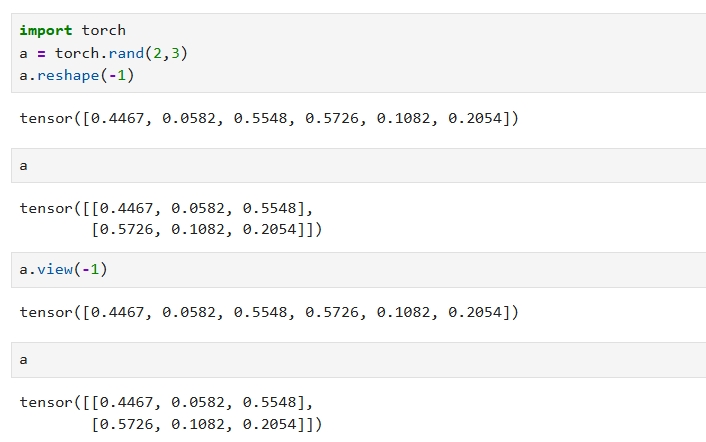
转为1维
label = np.array(y_train)
if label.ndim > 1:
    label = label.ravel()  # 转换为一维数组
label.shape
ravel 英/ˈrævl/ 美/ˈrævl/

vt. 使…缠绕;使更复杂;使更纷乱
n. 缠绕;(绳,织物等)散开的一端;错杂
|
|
|
|
|
|
|
|
行操作
```
elem_i_row = a[i]          # 形状 (cols,)
rest       = np.delete(a, i, axis=0)  # 去掉第 i 行后的数组
```
|
|
|
|
|
|
|
|
|
|
|
|
|
|
参考文章