交叉熵使用示例
文本类
文本拆分为单词,单词转化为索引,进而句子转化为索引向量
入模型时,需要将索引向量转化为矩阵,即每个单词化为一个向量
预测时,又需要将向量转化为索引,进而与字典中的单词对应
在索引转向量时,是随机的,
一个随机的向量反向对应索引时,偏差就比较大
可以在入模前就训练一批向量参数,使 索引 -- 向量参数 -- 索引 之间有一一对应关系

一个索引,比如index=2,对应的就是向量a,
如果得到一个向量a,就立即确定它唯一对应index=2
进一步简化,直接求解一个参数矩阵,func(index) ~ func(param_mat) ~ one hot向量 ~ 最大值的位置索引

模型输入的是index,param_mat即包含了index的信息,又包含了模型的规律,还能通过func转化为one hot向量
文本类交叉熵举例
import torch
from torch import nn

dict_count = 3 #有三个单词,索引为0,1,2
seq_len = 5
batch_size = 2


#`low` (inclusive) and :attr:`high` (exclusive).
data = torch.randint(low=0, high=dict_count, size=(batch_size,seq_len))
data
tensor([[0, 0, 2, 1, 2],
        [0, 2, 0, 0, 0]])
label = data
label.shape
torch.Size([2, 5])

#对X进行编码
embed = nn.Embedding(num_embeddings=dict_count, embedding_dim=dict_count, padding_idx=0)
X = embed(data)
现在求X与label之间的偏差
注意X与label的shape并不一样,交叉䊞能自动处理这一点,
但第1维必须是一样的,最多2维,高于2维的必须展平
认为X[0]的向量,对应y[0]转化后的One hot向量
X = X.reshape(-1,dict_count)
label = label.reshape(-1)
print(X.shape,label.shape)  #torch.Size([10, 3]) torch.Size([10])

loss_fn = nn.CrossEntropyLoss()
loss = loss_fn(X,label)
loss
tensor(1.3767, grad_fn=NllLossBackward0)
交叉熵API说明
|
torch.nn.CrossEntropyLoss()
This criterion computes the cross entropy loss between input logits and target.
criterion  美 /kraɪˈtɪriən/ n.标准;(评判或作决定的)准则;原则

Init signature:
nn.CrossEntropyLoss(
    weight: Optional[torch.Tensor] = None,
    size_average=None,
    ignore_index: int = -100,
    reduce=None,
    reduction: str = 'mean',
    label_smoothing: float = 0.0,
) -> None
使用 loss_fn=nn.CrossEntropyLoss() loss = loss_fn(input,target) input: 输入 target: 标签 input input没啥可注意的,重点是后面的target unnormalized 非归一化;非标准的 The `input` is expected to contain the unnormalized logits for each class (which do `not` need to be positive or sum to 1, in general). `input` has to be a Tensor of size :math:`(C)` for unbatched input, :math:`(minibatch, C)` or :math:`(minibatch, C, d_1, d_2, ..., d_K)` with :math:`K \geq 1` for the `K`-dimensional case. The last being useful for higher dimension inputs, such as computing cross entropy loss per-pixel for 2D images. 交叉熵的输入(input)的shape,可以是 [特征维度],没有批次的维度,只有特征的维度, 言外之意就是一行数据,一个样本, 这个特征维度就是模型的最后一层的维度,也是标签的维度 比如,模型输出[0.1,0.9] 跟对应的标签[0,1]求损失, 这是标准的,也是直接按数学理论转换过来的求交叉熵的格式 [batch_size, C],这说明交叉熵可以按批次求损失 [batch_size,C,H,W] 这是典型的2维图像的格式, 直接将这个格式作为交叉熵的损失函数也是可以的 target
indices 英/ˈɪndɪsiːz/  美/ˈɪndɪsiːz/ (index 的复数形式之一);索引;标志,迹象;

The `target` that this criterion expects should contain either:
- Class indices in the range :math:`[0, C)` where :math:`C` is the number of classes;
假设特征数C=3,那么
for i in range(3):
    print(i)

输出:
0
1
2
意思是说,如果标签类别有3,那么标签的编码应该是[0,1,2]

这就是后面的 索引标签计算交叉熵
|
|
loss = loss_fn(y_pred, y) y是1维列表
import os
from tpf import pkl_save,pkl_load
BASE_DIR = "/wks/datasets/hotel_reader"
file_path = os.path.join(BASE_DIR,'data_pkl/word.pkl')
X_train,y_train,X_test,y_test,words_set,word2idx,idx2word = pkl_load(file_path)

# 字典长度
dict_len = len(words_set)

# 序列长度
seq_len = 512

# 训练集
X_train1 = []
for x in X_train:
    temp = x + ["<PAD>"] * seq_len
    X_train1.append(temp[:seq_len])

# 测试集
X_test1 = []
for x in X_test:
    temp = x + ["<PAD>"] * seq_len
    X_test1.append(temp[:seq_len])


"""
    索引向量化
"""
# 训练集向量化

X_train2 = []
for x in X_train1:
    temp = []
    for word in x:
        idx = word2idx[word] if word in word2idx else word2idx["<UNK>"]
        temp.append(idx)
    X_train2.append(temp)


# 测试集向量化

X_test2 = []
for x in X_test1:
    temp = []
    for word in x:
        idx = word2idx[word] if word in word2idx else word2idx["<UNK>"]
        temp.append(idx)
    X_test2.append(temp)


"""
    构建数据集
"""
import numpy as np
from torch.utils.data import Dataset
from torch.utils.data import DataLoader
import torch
from torch import nn
from torch.nn import functional as F

class MyDataSet(Dataset):

    def __init__(self, X=X_train2, y=y_train):
        self.X = X
        self.y = y

    def __len__(self):
        return len(self.X)

    def __getitem__(self, idx):
        x = self.X[idx]
        y = self.y[idx]

        return torch.tensor(data=x).long(), torch.tensor(data=y).long()

train_dataset = MyDataSet(X=X_train2, y=y_train)
train_dataloader = DataLoader(dataset=train_dataset, shuffle=True, batch_size=128)

test_dataset = MyDataSet(X=X_test2, y=y_test)
test_dataloader = DataLoader(dataset=test_dataset, shuffle=False, batch_size=256)
train_dataset[0][0][:7]

tensor([ 5004, 10135, 20586,  9530, 16808, 14513,  9530])
train_dataset[0][1]
1


for X,y in test_dataloader:
    print(X.shape,y.shape)
    break

torch.Size([256, 512]) torch.Size([256])


二分类问题中,loss = loss_fn(y_pred, y), y是1维列表
|
|
标签y是long类型,类别是用整数表示的
"""
    构建数据集
"""
import numpy as np
from torch.utils.data import Dataset
from torch.utils.data import DataLoader
import torch
from torch import nn
from torch.nn import functional as F

class MyDataSet(Dataset):

    def __init__(self,X,y):
        """
        构建数据集
        """
        self.X = X
        self.y =  y.reshape(-1)
        # self.y = y.reshape(-1,1)

    def __len__(self):
        return len(self.X)

    def __getitem__(self, idx):
        x = self.X[idx]
        y = self.y[idx]

        return torch.tensor(data=x).float(), torch.tensor(data=y).long()
|
|
|
|
|
one hot标签计算交叉熵
import torch
from torch import nn
import numpy as np

input = torch.tensor([0,0,1],dtype=torch.float32,requires_grad=True)
# target = torch.tensor(2,dtype=torch.long)  # 0.5514
target = torch.tensor([0,1,0],dtype=torch.float32)  # 1.5514
# target = torch.tensor(0,dtype=torch.long)             # 1.5514

loss = nn.CrossEntropyLoss()
output = loss(input, target)
output.backward()
output
tensor(1.5514, grad_fn=DivBackward1)
索引标签计算交叉熵
import torch
from torch import nn
import numpy as np

input = torch.tensor([0,0,1],dtype=torch.float32,requires_grad=True)
# target = torch.tensor(2,dtype=torch.long)  # 0.5514
# target = torch.tensor([0,1,0],dtype=torch.float32)  # 1.5514
target = torch.tensor(0,dtype=torch.long)             # 1.5514

loss = nn.CrossEntropyLoss()
output = loss(input, target)
output.backward()
output
tensor(1.5514, grad_fn=NllLossBackward0)

该例表明,交叉熵在输入的标签是整数时,默认将其转换为one hot标签,无须再手工转换,其效果与One Hot标签一致
批次损失计算
reduction: str = 'mean'
每个样本与标签都有一个损失, 如果输入的是批次,交叉熵默认情况下求出的损失是批次样本损失的均值 reduce参数已废弃,看reduction,其默认值为mean batch_size = Nwhere :math:`x` is the input, :math:`y` is the target, :math:`w` is the weight, :math:`C` is the number of classes, and :math:`N` spans the minibatch dimension
批次损失计算
import torch
from torch import nn
import numpy as np

# loss 1.0514
x = [[0,0,1],[0,0,1]]
y = [[0,1,0],[0,0,1]]

# 1.5514
x = [[0,0,1]]
y = [[0,1,0]]

# 0.5514
x = [[0,0,1]]
y = [[0,0,1]]

input = torch.tensor(x,dtype=torch.float32,requires_grad=True)
# target = torch.tensor(2,dtype=torch.long)
target = torch.tensor(y,dtype=torch.float32)
# target = torch.tensor(0,dtype=torch.long)

loss = nn.CrossEntropyLoss()
output = loss(input, target)
output.backward()
output

(0.5514+1.5514)/2 = 1.0514

每个样本与标签都有一个损失,
如果输入的是批次,交叉熵默认情况下求出的损失是批次样本损失的均值
转成索引标签也一样
import torch
from torch import nn
import numpy as np

# loss 1.0514
x = [[0,0,1],[0,0,1]]
y = [[0,1,0],[0,0,1]]
y = [1,2]  #按one hot编码的方式,这时共有3个类别

input = torch.tensor(x,dtype=torch.float32,requires_grad=True)
target = torch.tensor(y,dtype=torch.long)

loss = nn.CrossEntropyLoss()
output = loss(input, target)
output.backward()
output
tensor(1.0514, grad_fn=NllLossBackward0)
交叉熵公式
借pytorch交叉熵的API文档推一下交叉熵的数学公式
Probabilities for each class;
useful when labels beyond a single class per minibatch item are required,
such as for blended labels, label smoothing, etc.
The unreduced (i.e. with :attr:`reduction` set to ``'none'``) loss for this case can be described as:
.. math::
    \ell(x, y) = L = \{l_1,\dots,l_N\}^\top, \quad
    l_n = - \sum_{c=1}^C w_c \log \frac{\exp(x_{n,c})}{\sum_{i=1}^C \exp(x_{n,i})} y_{n,c}

where
:math:`x` is the input,
:math:`y` is the target,
:math:`w` is the weight,
:math:`C` is the number of classes, and
:math:`N` spans the minibatch dimension as well as
:math:`d_1, ..., d_k` for the `K`-dimensional case.
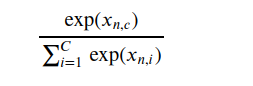
上图就是softmax,对x中的每个元素进行指数运算,然后再除以指数的和,
其和为1,
它真正要表达的意思是,概率和为1,

比如,二分类问题,类型共有两个,[发生,不发生],[是,否],
总类别个数为C,这是全集,
一个事物不在这个类型,就必定在那个类别中

softmax处理的对象是模型的输出,为什么不对标签这么处理?
因为标签本身很固定,确切地说是你亲自编码的,它属于哪个类别是铁板钉钉的事,一算就知
而模型的输出那可真是乱七八糟,五花八门,
你期望模型输出0.9,期望它接近你的标签1,
但实际上它可能输出的是-0.7,直接就违反了概率要大于1的理论基础啊
怎么办?
常用的办法是用softmax处理一下,
将模型在各个类别上的差异,转化为符合概率理论的差异
xn是一个向量,指批次中第n个样本,它有C个维度(C是类别个数),

yn就是标签,也是一个向量,也有C个维度(C是类别个数),
特别地,如果对标签使用one hot编码(实际上,通常,就是这么做的)
yn中只有一个维度为1,其他维度皆为0

比如,二分类问题,类型共有两个,one hot编码是下面这样的
发生用[1,0]向量表示,不发生用[0,1]向量表示
二者在距离上完全一样,没有差异

0乘以任何数还是0,C维度的计算,只算标签为1的那个维度就可以了,
同时先不考虑权重的问题,上面的公式简化为:
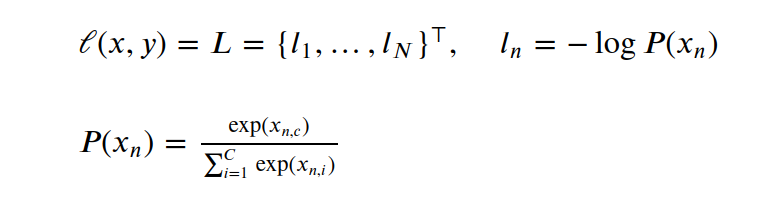
如此,每个样本与标签的交叉熵损失,转化为模型输出的 信息量
训练的目的转化为,让模型输出的信息量,越来越小,
小到很容易就分出是哪个类别时,就达到目的了

xn是一个向量,xnc指与yn标签1所在索引对应的x的值,
因为其他位置都是与0相乘,乘完就消失了
因此P(xn)就 只是 其中与标签1对应索引位置的x占xn的概率
交叉熵权重
It is useful when training a classification problem with `C` classes.
If provided, the optional argument :attr:`weight` should be a 1D `Tensor`
assigning weight to each of the classes.
This is particularly useful when you have an unbalanced training set.
torch.nn.BCELoss(Binary Cross-Entropy Loss)
用途:做单标签二分类(或多标签、多类别二分类)时,把 单个 sigmoid 输出 与 0/1 标签 做逐元素交叉熵计算。

前提:
网络最后一层 不加 softmax/sigmoid,
而是在 损失函数外部手动做 sigmoid(或直接让网络输出 logits,再配合 BCEWithLogitsLoss)。

标签 y 必须是 float 型的 0/1 张量,形状与网络输出完全一致。
单标签二分类(一个样本只有一个正/负标签)
import torch
import torch.nn as nn

# 假设 batch_size=4,输出维度=1(正类概率)
logits = torch.tensor([2.0, -1.0, 0.5, 3.0])       # 网络最后输出
labels = torch.tensor([1.0, 0.0, 0.0, 1.0])        # 0/1 标签

# 先把 logits 压缩到 (0,1)
probs = torch.sigmoid(logits)

# 实例化 BCELoss
criterion = nn.BCELoss()
loss = criterion(probs, labels)

print(loss.item())      # 0.36571353673934937
|
# 3 个样本,每个样本有 5 个可能的标签,可重叠
logits = torch.randn(3, 5)          # 网络输出
labels = torch.tensor([[1, 0, 1, 0, 0],
                        [0, 0, 0, 1, 1],
                        [1, 1, 0, 0, 0]], dtype=torch.float)

probs = torch.sigmoid(logits)       # 逐元素映射到 (0,1)
criterion = nn.BCELoss()
loss = criterion(probs, labels)
print(loss.item())   # 0.7811753749847412
二分类需要模型输出到1维向量上,标签也是1维 多分类,模型输出与标签的维度都是2维 |
model = MyNet()              # 最后一层是 nn.Linear(..., 1) 或 nn.Linear(..., num_classes)
optimizer = torch.optim.Adam(model.parameters(), lr=1e-3)
criterion = nn.BCELoss()

for x, y in loader:          # y: float 型的 0/1 张量
    optimizer.zero_grad()
    logits = model(x)        # 不 sigmoid
    loss = criterion(torch.sigmoid(logits), y)
    loss.backward()
    optimizer.step()
问题	                                  正确做法
网络最后一层直接接了 sigmoid,又用 BCELoss	去掉最后 sigmoid,或将损失函数改为 BCEWithLogitsLoss(自带数值稳定的 sigmoid)
标签是 LongTensor 或含 2,3,4…	           转成 FloatTensor 并确保只有 0/1
类别不平衡	                               使用 pos_weight 参数(BCEWithLogitsLoss 支持)
    一句话总结:
    当你需要 逐元素 比较 概率值 和 0/1 标签 时,用 BCELoss;若想让损失函数内部做 sigmoid 并提高数值稳定性,用 BCEWithLogitsLoss。
|
BCEWithLogitsLoss = Sigmoid + BCELoss 的合并实现,数值更稳定;
当正负样本极度不均衡时,可通过 pos_weight 给“正样本损失”加权,抵消类别失衡。
场景设定 1000 个样本,只有 20 个正样本(正:负 ≈ 1:49)。 网络对每个样本输出 单个 logit(二分类)。 计算 pos_weight 公式:pos_weight = (#负样本) / (#正样本) pos_w = torch.tensor([(1000-20)/20]) # tensor([49.0]) 代码示例 import torch import torch.nn as nn # 模拟 batch_size=4,每个样本 1 个 logit logits = torch.tensor([ 1.5, -2.0, 0.3, -0.8 ]) # 网络输出 labels = torch.tensor([ 1.0, 0.0, 0.0, 1.0 ]) # 0/1 标签(float) # 正样本极少,用 pos_weight 增加其损失权重 pos_weight = torch.tensor([49.0]) # 49 = 980/20 criterion = nn.BCEWithLogitsLoss(pos_weight=pos_weight) loss = criterion(logits, labels) print(loss.item()) # 17.058616638183594 比不加权重时大,迫使模型更关注正类 pos_weight 给“稀缺类别”的损失乘上 大于 1 的系数, 使模型在反向传播时 更关注少数类,从而缓解类别不平衡。 |
|
|
参考